
Small states like ours can make a difference.
But when we sit on the fence, we harm our national interests.

If you enjoyed this post, please consider sharing it with a few friends. If this was forwarded to you, please sign up to receive my posts directly in your inbox.
For the past couple of decades, the New Zealand government has picked its words extremely carefully when talking about China lest Beijing use its economic power to retaliate against political statements.
Now, we’re doing the same with the United States.
I understand why we need to be careful when it comes to China: Beijing has an inglorious track record of expressing its displeasure with economic retaliation. Just ask the beef and wine producers of Australia, or the pork farmers and canola growers of Canada. Still, I think we could be more forthright with Beijing than we have been, especially regarding its maritime aggression and territorial expansion in the Pacific.
But it’s the mincing around the United States, once the flagbearer for democracy and freedom of speech, that marks an alarming development for a country that still espouses to have an “independent” foreign policy.
Prime Minister Christopher Luxon has led a momentous “reset” in New Zealand’s foreign policy, aligning our country much more closely with the United States, an approach that’s been most visible in the weeks of silence and avoidance following Luxon’s fumbling initial reaction to President Donald Trump’s war of choice against Iran.
Even on Radio New Zealand this morning, Luxon evaded questions about why he had condemned Iran for its retaliation but not the Trump administration for committing war crimes like bombing civilian infrastructure that will hurt the 93 million people of Iran, the vast majority of whom do not support the theocratic regime. “Unhelpful” was as far as Luxon would go.
This comes after six weeks in which the US has clearly shown it has no clear goal or endgame for the war, is capricious and happy to unleash chaos in the global economy and particularly at the petrol pump.
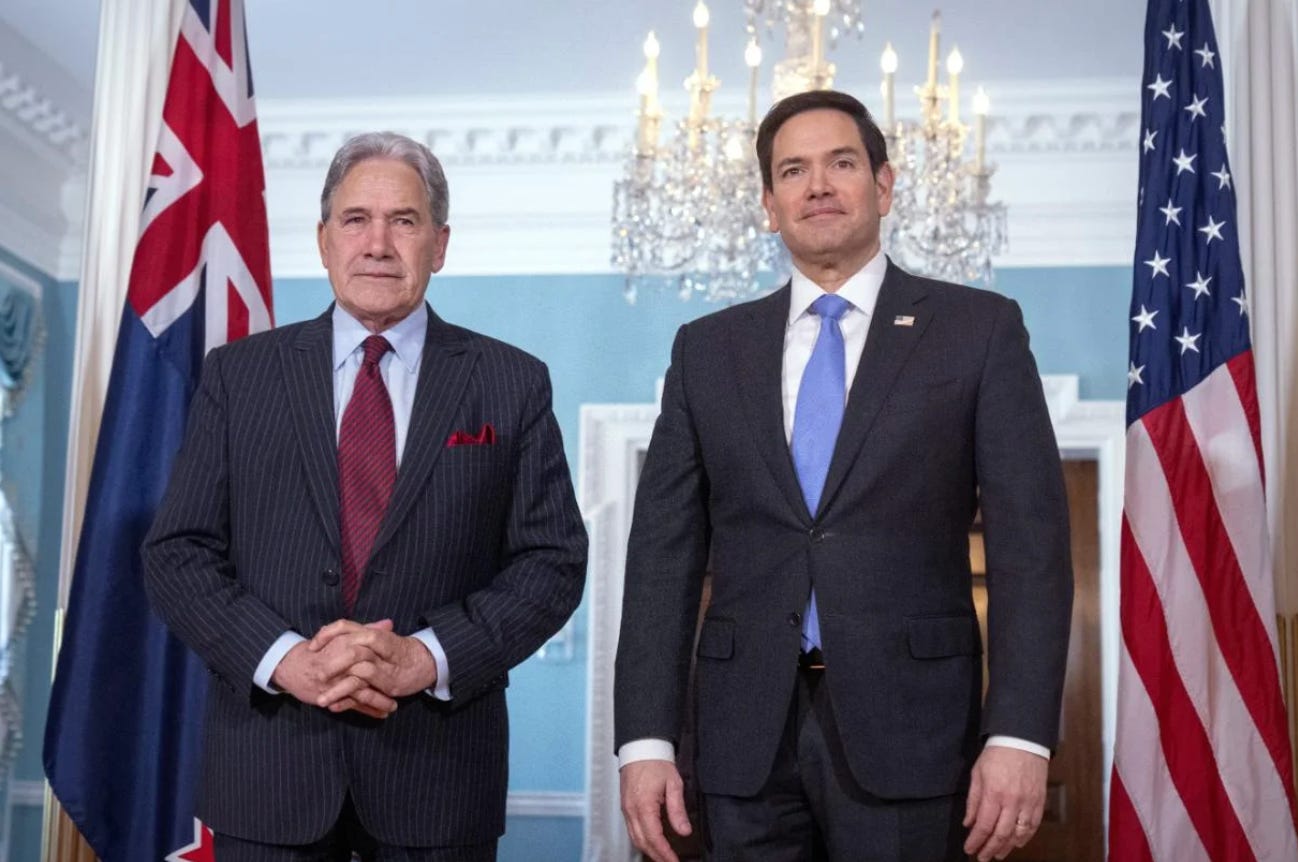
Foreign Minister Winston Peters — who is fully signed up to Luxon’s pivot to the US — is in Washington this week and will be meeting Secretary of State Marco Rubio on Tuesday. That’s the day that Trump has declared “Power Plant Day, and Bridge Day” in Iran as he threatens to bomb Iran “back to the Stone Ages” if Tehran doesn’t agree to a ceasefire and to open the Strait of Hormuz.
I’m not holding my breath waiting for a sternly-worded condemnation from Peters – who stuck with the US in declining to recognise the state of Palestine at the United Nations last year, and has taken an increasingly Trumpian approach to the World Health Organisation.
What has our silence achieved? It certainly hasn’t moderated Trump in any way. We haven’t moved him to introspection or restraint.
Some would say that by remaining silent, we have not risked provoking the US president’s wrath, as Spanish Prime Minister Pedro Sánchez did. He became the face of European opposition to the war against Iran when he refused to allow the US military to use jointly-operated military bases in the country for operations related to the war.
“You can’t respond to one illegality with another because that’s how humanity’s great disasters begin,” Sánchez said at the beginning of March.
Trump responded angrily, threatening to cut off American trade with Spain. (He hasn’t.)
Since then, more European leaders have spoken out, including French President Emmanuel Macron (“We all need stability, calm, a return to peace — this isn’t a show!” he said last week) and the office of German Chancellor Friedrich Merz.
It’s a notable change in approach for Europe, where many leaders had previously opted for the flattery approach to avoid exacerbating the trade war. It didn’t work: Trump imposed tariffs on friends and foes alike.
The parapet problem
So what about us, down here in New Zealand? We continue to keep our heads down, hoping that Trump will just forget about us. We’re small and out of the way. We don’t have a meaningful military contribution to make. Let’s just whistle and look away.
The problem is this: When we hide behind the parapet, we harm our national interests.
Let’s think about the near-term considerations. Trump’s war of choice is wreaking havoc on our economy and therefore our livelihoods. Diesel prices are through the roof, petrol and jet fuel are close behind, threatening the entire logistical basis of our country.
There are effects we haven’t even started to feel yet: Australia — which supplies about 75 percent of New Zealand’s wheat — will plant less because of fertiliser shortages caused by the invasion of Iran. Keto diet, anyone?
These implications alone give us reason to speak up.
But then there is the bigger picture. New Zealand, as I wrote on Friday, benefits from the international rules-based order where might doesn’t equal right.
If we are concerned about the foundations of our country and a stable future, we should be speaking up on the importance of international norms meant to protect democratic values, human rights and fair, open economic systems. Just as we have done following Russia’s illegal invasion of Ukraine.
That may have been much easier for us since Russia was such a tiny export market, but we, as a trading nation, will be far worse off in the long run if we kowtow to Trump for fear of tariffs or other forms of retaliation now.
Plus, we ought to be able to have a grown-up conversation with the United States, with which we are aligned even if we are not allies. As Sánchez told The Wall Street Journal recently: “Good allies are like good friends. We tell each other the truth no matter what.”
If we want to continue saying that we have an “independent foreign policy” (which, by the way, every country thinks it has), then we need to be able to convey our concerns and advocate for our values no matter how big and powerful the country on the receiving end. We are smart enough to do that diplomatically but clearly.
A rupture or a transition?
Canadian Prime Minister Mark Carney, who warned earlier this year that the global order was not in transition but in the middle of a “rupture”, has been urging middle-sized countries to band together.
Even though we are small and were not on Carney’s recent travel schedule through India, Australia and Japan, we can make a difference in the world by banding together with countries — small and medium — where our values and interests align.
We can also help determine whether his core thesis about rupture rather than transition proves true.
We can become more than the sum of our parts, especially in a “multipolar order,” where smaller countries have greater room to manoeuvre between the poles of the United States and China.
Some examples of where small or mid-sized countries worked together to make a difference.
After Russia invaded Ukraine, Finland (population 5.6 million) and Sweden (population 10.7 million) both abandoned their longstanding policies of military non-alignment and joined the collective defence of NATO.
And Lithuania (population not quite 3 million) stood up to China after Beijing took umbrage at what it viewed as Lithuanian recognition of Taiwan. China retaliated with harsh trade-related sanctions, but the EU banded together to defend its member.
The Lithuanian case showed how small and medium states, by acting collectively, can mitigate asymmetries when confronting great-power economic pressure, Stephen Nagy, a professor at International Christian University in Tokyo, wrote in this helpful paper.
We may not have the kind of economic or military power that can alter the balance of power, but we too can forge strong relationships and use our influence to promote and defend international laws and institutions. We can also help tilt the balance more in favour of countries that were short-changed in the post-WWII multilateral order or otherwise underrepresented.
Finnish Prime Minister Alexander Stubb wrote about this in a powerful essay for Foreign Affairs magazine published last year, headlined “The West’s Last Chance.” Here’s a key quote:
Every state has agency, even small ones such as mine, Finland. The key is to try to maximise influence and, with the tools available, push for solutions. For me, this means doing everything I can to preserve the liberal world order, even if that system is not in vogue right now. International institutions and norms provide the framework for global cooperation. They need to be updated and reformed to better reflect the growing economic and political power of the global South and the global East. Western leaders have long talked about the urgency of fixing multilateral institutions such as the United Nations. Now, we must get it done, starting with rebalancing the power within the UN and other international bodies such as the World Trade Organization, the International Monetary Fund, and the World Bank. Without such changes, the multilateral system as it exists will crumble. That system is not perfect; it has inherent flaws and can never exactly reflect the world around it. But the alternatives are much worse: spheres of influence, chaos, and disorder.
As the United States becomes a less reliable steward of the international order, small and mid-sized states can act as a balance in a very unbalanced world and stave off fragmentation. We can help hold together the international order and repair the rupture.
Peters could use his audience with Rubio tonight to convey how aghast New Zealanders are at the wanton recklessness of one man, the complete disregard for international law, the human tragedy he is creating and the upheaval he is unleashing on the global economy.
In this way, to use another favourite Kiwi saying, we can punch above our weight.
Fantastic analysis. I take a lot of heart from the Lithuanian case, and hope that - as you say ‘small and medium states, by acting collectively, can mitigate asymmetries when confronting great-power economic pressure’
Your analysis is painfully on the mark. We have had an unsanctioned re-set of our international alignment.
In the inimitable parlance of his Foreign Minister, I think our PM this morning sounded like a lanyard wearing, soft-handed, gluten free, half-acre soy boy. When he had the opportunity to sound even-handed by condemning American attacks on civilian infrastructure (as he had for Iran's), he botched it.
When it's in a tight spot, this government has an uncanny ability to always choose the wrong options.